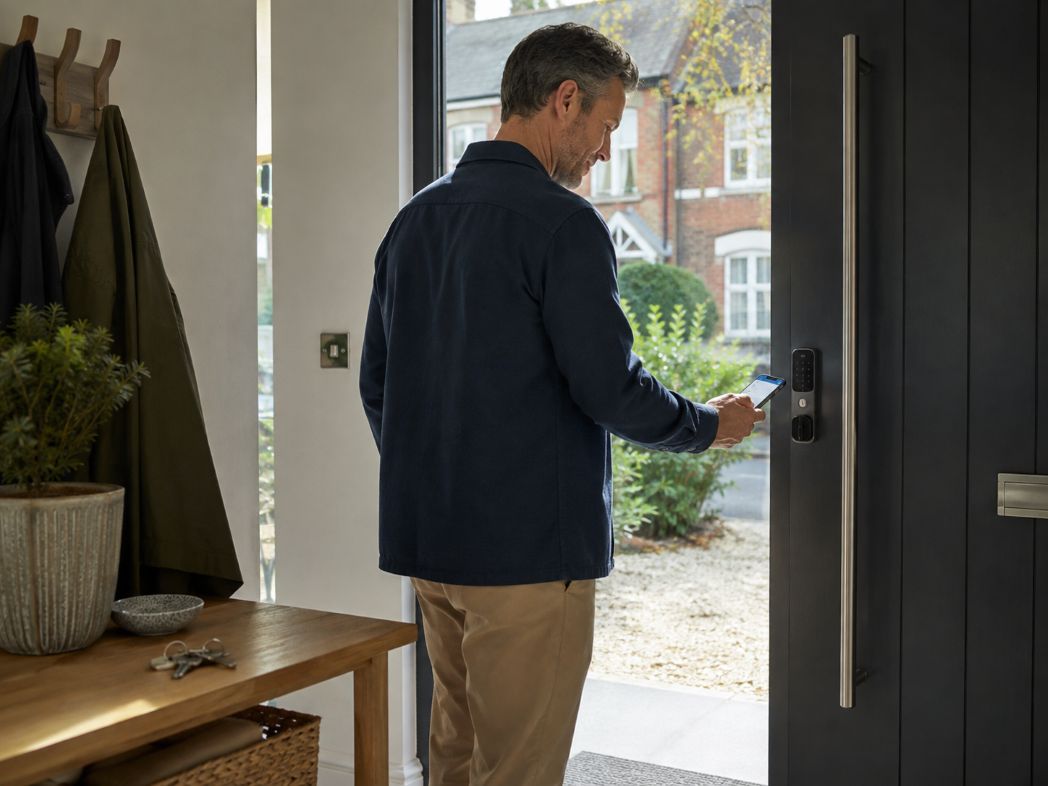
Keyless entry is becoming a more visible part of home security as households add connected devices to daily routines. YouGov reported in 2025 that 18% of Britons owned smart home security cameras. UK government research also found that safety and security products were the largest category in a sample of more than 1,000 consumer connected products sold in the country. Smart locks remain less common than cameras, but they are part of the same shift toward connected security.
For homeowners, the change is less about abandoning every physical key and more about choosing how access should work. Modern door entry solutions can use PIN codes, smartphone apps, fobs, fingerprints, or a mix of these methods. Some replace the existing cylinder. Others fit over a mechanical lock and turn it electronically. This gives households more control over who can enter and when.
What Changes When the Key Becomes Digital?
A traditional lock depends on a physical key matching the mechanism inside the cylinder. A smart lock adds electronic control. Which? explains that many models use a small motor to operate the lock after the user is verified through an app, code, fingerprint, or keycard. Bluetooth models usually work when an authorised phone is nearby. Wi-Fi models can support remote access.
This changes how spare access is handled. A resident may be able to create a temporary code for a relative, cleaner, tradesperson, or guest instead of cutting another key. Some systems also keep access logs or send alerts when the door is used.
Codes, Apps, and Remote Access Work Differently
Keypads are among the simplest keyless options. The user enters a stored number to release the lock. Codes can often be changed without replacing hardware, which is useful when access is temporary. Codes that are widely shared or easy to guess can weaken security.
App-based locks may use Bluetooth for nearby access or Wi-Fi for control from farther away. The South East Cyber Crime Unit notes that Wi-Fi-enabled smart locks can allow access when the user is away from home, while Bluetooth systems normally require closer proximity. Remote control is convenient, but it also makes account security important.
The National Cyber Security Centre advises smart-device users to create strong passwords, enable two-step verification where available, install updates, and turn off remote access when it is unnecessary. These steps matter because weak passwords and outdated software can create risks that do not exist with a purely mechanical lock.
Security Still Depends on the Door Itself
Digital features do not remove the need for strong physical hardware. A smart lock is still attached to a door, frame, cylinder, and locking mechanism. Good home safety measures also involve looking at the wider security of entrances, windows, and other access points around the property. Which? advises homeowners to check insurance considerations before changing a front-door lock because some policies can specify the type or standard of lock required.
Software support matters too. Research from NIST found that smart-home users can be unclear about whether devices are receiving updates, even though updates help fix security problems. NIST has also warned that unsupported devices may remain connected after manufacturers stop providing patches. Buyers should therefore check how long a lock will receive security support.
UK Rules Have Raised the Security Baseline
The Department for Science, Innovation and Technology states that the UK Product Security and Telecommunications Infrastructure regime took effect on 29 April 2024. The rules cover consumer connectable products and include restrictions on easily guessed default passwords, requirements for reporting security issues, and information about minimum security-update periods.
The Office for Product Safety and Standards later reported that it assessed 82 connected home, lifestyle, and child-related products during 2024 to 2025. It found varying levels of non-compliance in 75% of products within scope. The figure does not refer only to locks, but it shows why connected devices need scrutiny beyond convenience.
Why the Shift Keeps Reaching Local News
Keyless technology attracts attention because it sits where convenience and security meet. Local crime reporting has already made people familiar with electronic access risks through stories about keyless vehicle theft. In May 2026, Cheshire’s Silk 106.9 carried a police warning after a keyless car theft in Northwich. Vehicle systems differ from home smart locks, but the coverage keeps digital access and electronic security in public discussion.
Interest is also supported by wider smart-home adoption. YouGov found that 91% of Britons were aware of smart-home appliances in 2025. As cameras, alarms, video doorbells, and electronic locks share the same home-security environment, local coverage is likely to keep asking how useful these tools are and how safely they are used.
A Front Door Is Becoming Part of the Connected Home
Traditional keys are unlikely to disappear soon. They are simple and need no app, battery, or internet connection. Keyless systems, however, can offer temporary permissions, remote control, and access records.
For households considering the change, the main question is whether the system fits the door, the people using it, the home network, and the household’s security habits. The move away from traditional keys reflects a broader change in how homes manage access. It brings more convenience, but it also adds new responsibilities for passwords, updates, physical security, and long-term device support.


